
St George's House,
Northern Police Orphanage. 1898-1956
Harrogate, Yorkshire, England.


The Armed Services
Many of the men & women who were raised at St George's House, fought in the First and Second World Wars and for that matter
in many of the armed conflicts since then. The intention of this article is to draw attention to the participation of St George's men
and women in all of the services, including Nursing and the Police Force. Below are reproduced some of those photographs
showing their involvement.
Flanking the St George's flag are two photographs of the 1918 War Memorial. This memorial was donated in December 1918 by
Dr & Mrs Crawford Watson and was unveiled by the Rt Honourable John Grenfell Maxwell, PC,GCB,Commander in Chief, Northern
Command. The image portrayed on the memorial shows the vision of St George appearing to and succouring Richard,Coeur de
Lion. Inscribed in gold on the pediment are the words 'Deus Vult', being the Crusaders motto.
When St George's closed, the Memorial was relocated to St Mary's Church in Westcliffe Terrace then to St Andrew's Police
Convalescent Home (see photo below) and later, donated to the Ripon Museum.
A further memorial in memory of those from St George's who lost their lives in the Second World War was erected by the Old Boys
and Girls, Easter 1947, this memorial has recently been refurbished and is also cared for by the Ripon Museum (see photo below)
| World War. 1914 - 1918 | William S. Meehan | Sqn Ldr Leonard Cecil Parkes |
| Alfred Ashburne | Kathleen Webster | Jack & Dennis Grist |
| Richard Ashburne | Cadets | |
| World War. 1939 - 1945 | Lt Col (Rt'd) Peter Geraghty MBE,BEM. | |
| Richard H. Peacock D.F.C | John Newton | |
| Service Men & Women | Tom Berry | |
| Ethel Mary Orrell | Corporal John Philip Bly |
World War: 1914 - 1918


Thirty Seven old boys from St George's served during the First World War
and of these, 10 gave their lives.
The
Memorial shown above honours all who served and those that fell, it was
the gift of Dr and Mrs Crawford Watson
and the work of Yorkshire artist and
sculptor, Frances Darlington.
See Memorials page
for more information.

Police Constable John Ashburne, who was born in Cumbria, served with the
West Yorkshire Police Force,
Dewsbury Division. On his death in 1898, his two sons, Richard aged 11 &
Alfred aged 8, were cared for by St
George's, then called The Northern Police Orphanage. Their arrival in
1898 was shortly after the orphanage was
opened as can be seen by their admittance numbers which were Richard (6)
and Alfred (7).
The two boys emigrated to Canada in
the early 1900's and both of them served in the Canadian Armed Forces
in the First World War. Richard was killed in France and is buried
there, his grave is visited by members of his
family, most recently by Vaughn Ashburne, grandson of Alfred. Vaughn
still possesses the Bible which Miss
Catherine Gurney (founder of St George's House) presented to his
grandfather Alfred Ashburne.
Alfred Ashburne (7)
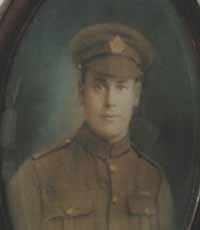
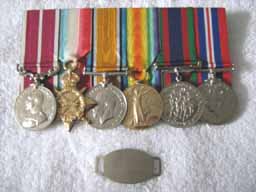

Medals awarded to Alfred
Ashburne Alfred Ashburne (aged
80)
Richard Ashburne (6)
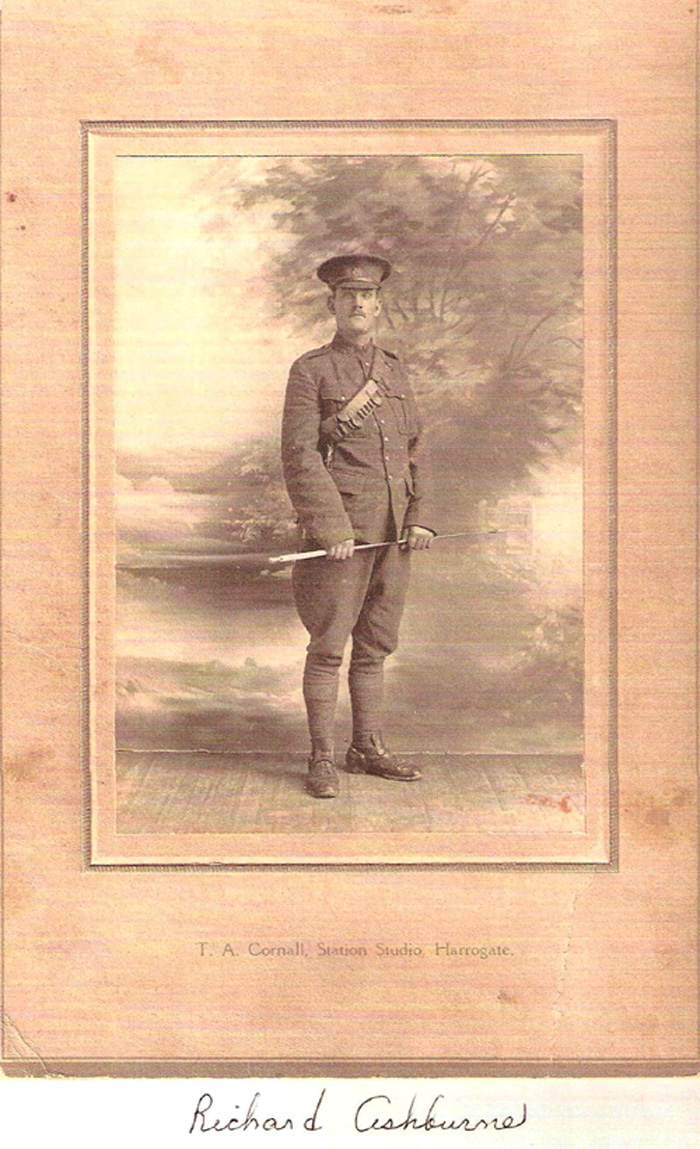

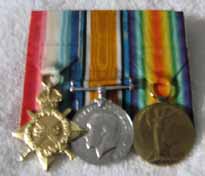
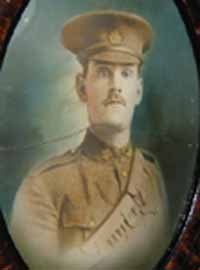
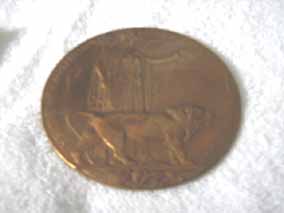
Medals awarded to R.
Ashburne
Bronze Medal awarded to R. Ashburne
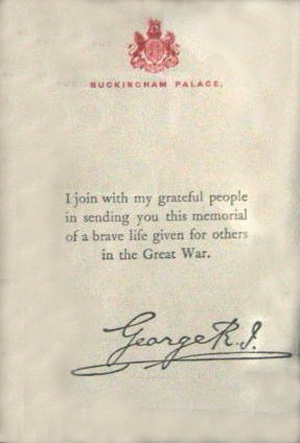
The Memorial letter signed
by King George, presented to Richard Ashburne's family on his death.

Vaughn Ashburne visiting
Richard's grave, France.
See also the War
Memorial 1914 - 18 on Memorials page, which bears the name of
Richard Ashburne
Photographs and
information kindly provided by Vaughn Ashburne. Further information
about PC J. Ashburne
is available on the Police Connections page of this website.
World War: 1939 - 1945

This Memorial was
erected by the 'Old' Girls and Boys in Easter 1947 to commemorate the 5
boys from St George's who lost their lives while serving with the Armed
Forces during the Second World War. The production of the memorial was
carried out by the firm of Robert Thomson, the 'Mouseman of Kilburn'.
See Memorials
page for more information.
Richard H. Peacock.
D.F.C.
6/4/1923
- 30/1/2005 (St George's old boy number 402)
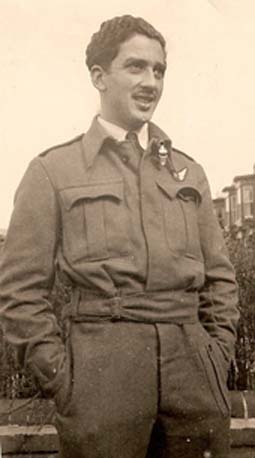

Pilot Officer R.H.Peacock (191819) RAF (VR) 640 Squadron
Awarded D.F.C. 25/9/1945 - London Gazette.
No. 640 Squadron was formed at Leconfield
on 7 January 1944 from C Flight of
No.158
Squadron. Equipped with Halifaxes, it took part in the bombing offensive
against Germany
until the end of the war and disbanded on 7 May, 1945.

Handley Page Halifax B III.
CITATION
Pilot Officer Peacock has completed
numerous sorties against enemy
targets during his first tour of operations. One night, in October,1944
when detailed to attack Cologne, P.O. Peacock was forced to make
a long bombing run through heavy anti-aircraft fire. Despite this, he
continued with his task and bombed the target successfully.
An excellent photograph was secured. This officer has displayed
untiring gallantry and devotion to duty.
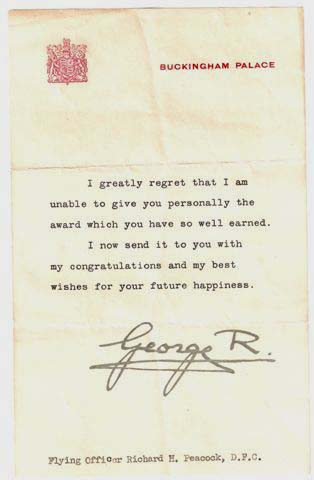
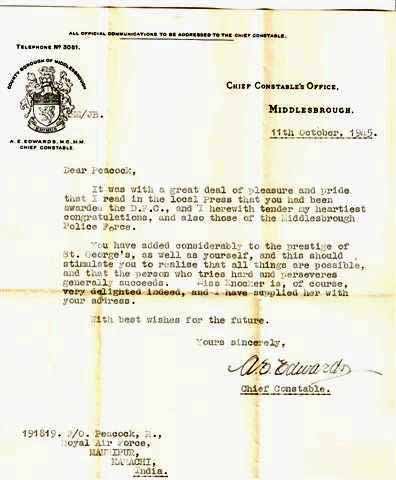

Letter of
congratulations to P/O R.H.Peacock written
Letter of congratulations to P/O R.H.Peacock
by Middlesbrough Chief Constable A.E.Edwards, dated
written by Preston Kitchen CBE, Town Clerk
11 October, 1945.
of Middlesbrough, dated 9 January, 1946
During the Second
World War, girls at the Orphanage knitted various articles for the
serving men, made camouflage
nets
and in conjunction with the St George's Scout Troop, collected salvage in the neighbourhood to contribute and
help in the war effort.
Service Men & Women
Some of the St
George's old boys and girls who served in the Armed Forces during World
War II.


Ethel Mary Orrell
(359)


William S. Meehan (223)
Kathleen Webster (302)
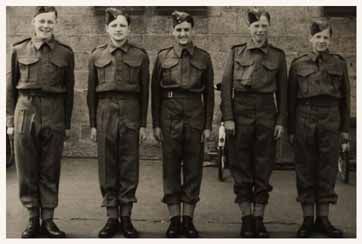
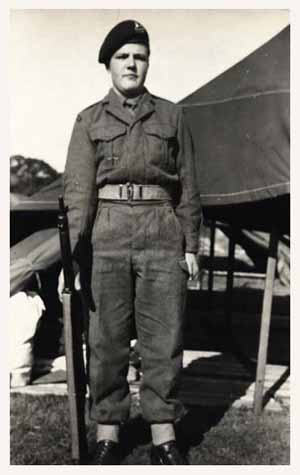

Cadets
c.1944. From left to right, Tom Ruddick, Ethel Mary
Orrell (359)
Geoffrey Whitaker,
Alfred Lewis, Frank Gilbert and
Jim Shepherd.

St George's
Army Cadets c 1942 - 43
Back: Malcolm Tait, Peter Waddington, Stanley Carter, John Williams
Front: Alfred Lewis, Frank Gilbert, Jim Shepherd
Lt Col (Rt'd) Peter A. Geraghty MBE, BEM.
St George's old boy number 548
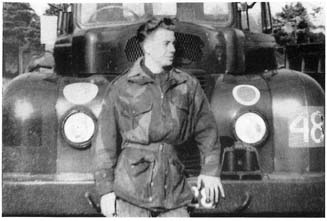

Peter A. Geraghty. Malaya 1956.
John Newton
St George's old boy number 549
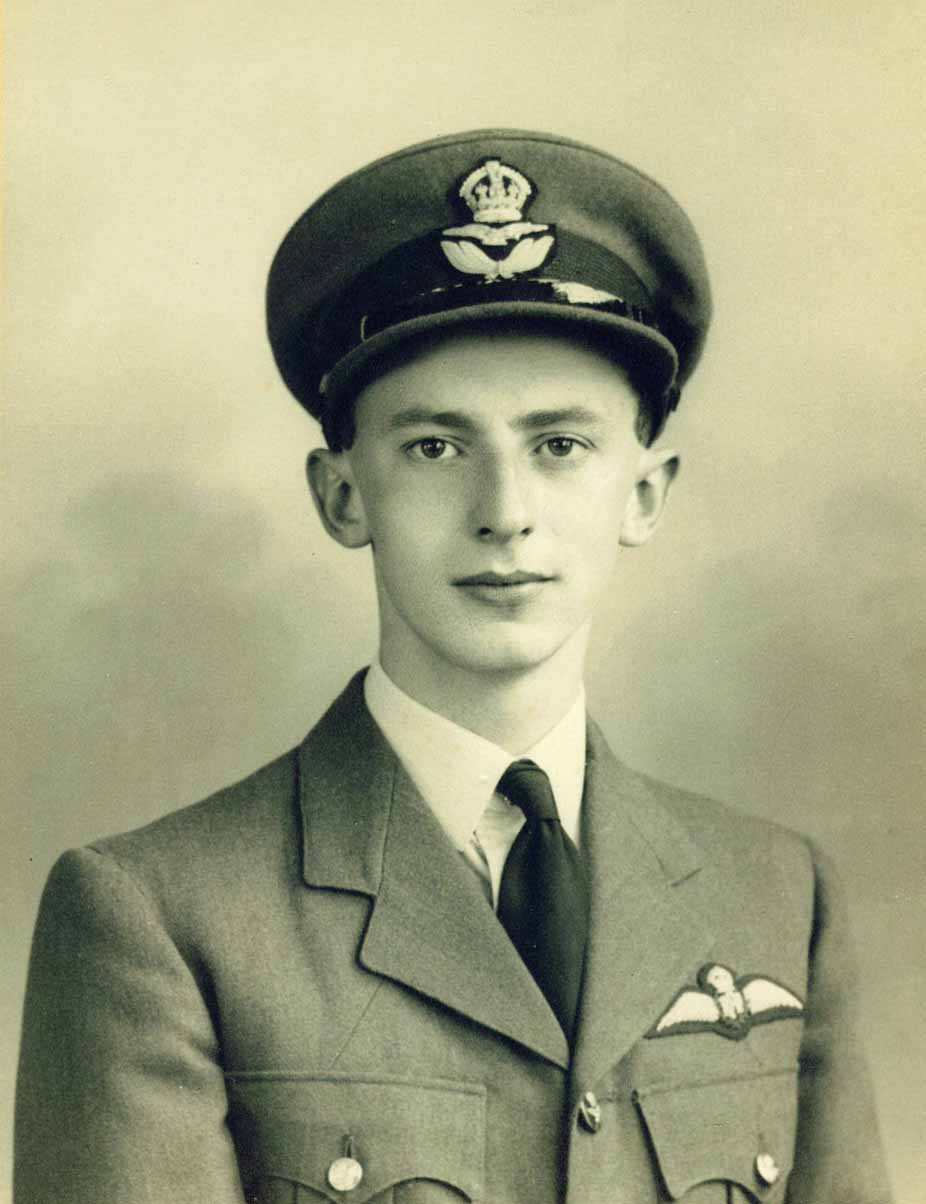

John Newton, May 1952. Gloster Meteor F.8
John gained his 'Wings' with the
RAF after training on Tiger Moths,
Harvards and the Gloster Meteor F.8
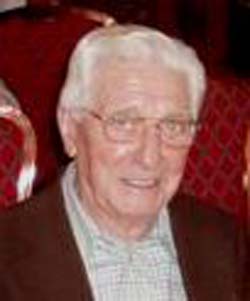
Tom
Berry
St George's old boy number 341
The War Years
Tom Berry: Army Services
Number 2581722
79th Armoured
Division
I was called up for full time service in 1939, having joined the
Territorial Army (Royal Signals) about a year earlier. After periods of
service with AA Signals, Northern Command Signals and as Orderly Room
Sergeant at 6th Armoured Division Signals I was posted with the same job
to 79th Armoured Division Signals in 1943.
The Division was unique in that it's tanks were adapted to deal, initially, with the various problems of terrain and defence, which would face our troops attacking the coast of northern Europe. These included amphibious tanks, on the face of it a contradiction in terms, which could be launched from tank landing craft some distance from the beach and then 'swim' ashore. There were also flame throwers, tanks with circulating heavy chains which cleared a path through minefields, others with a large bobbin of reinforced 'carpet' which could be unrolled over soft ground to provide a useable road for vehicles. There were also a number of others adapted in different ways to provide passage for vehicles over various obstacles.


A tank, flailing.
Tank carrying temporary 'road' surfacing.
A 'bobbin' tank
German 'V' Weapons
I think I probably heard the first of the V1's (buzz bombs) and V2's
(rockets) which the Germans launched. It was fairly early in June 1944,
the invasion of France was well under way, and the Division's tanks were
proving their worth. The administrative troops which included my staff,
were still in Southern England. Some time during the night I heard an
aircraft going over which I took to be an American Flying Fortress
limping home on one very dodgy engine. Suddenly the engine cut out and,
after a few seconds silence, there was quite a big explosion. I assumed
the Flying Fortress had not dropped all of its bombs on the mission and
that the crew, of which there were about ten, were lost. However, the
next day there was much talk about a pilotless plane and that no Flying
Fortress had crashed. I subsequently heard and saw many V1's and there
was no doubt that that was what I had heard for the first time.
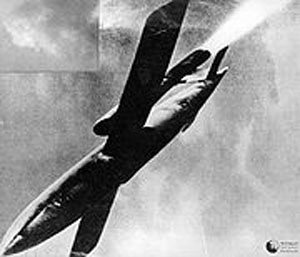

German V1 (buzz bomb)
German V2 Rocket
Some months later the
Division headquarters occupied what had been an hotel a few miles south
of Antwerp. One evening I was working in the office and had gone outside
when I heard a deep rumble coming from the sky. Looking up towards the
sound I saw a light coming down and, it seemed to be coming in my
general direction. As I hadn't the faintest idea what it was, it seemed
a good idea to squat down between two Jeeps which were parked fairly
close together. Fortunate that I did as, not too far away, there
was an enormous explosion and part of the hotel's roof came down, but
didn't hit me. Even more fortunate was the fact that the rocket, for
that was what it was, landed in very soft ground and left a large
crater, thus doing little other damage. If it had landed on a hard
surface the outcome might have been very different. I believe this
must have been the first of these weapons to be used as the following
day General Montgomery came to inspect the scene.
While we occupied this building we seemed to be on the regular flight
path for the V1's. On one occasion the Adjutant had come into my office
to talk about something or other when we heard a V1 approaching. As my
desk was immediately in front of the window we moved into the corridor
to finish our conversation. After a short while a little terrier came
along the corridor and sat between my legs, absolutely shaking with
fear. He was obviously well acquainted with V1's as immediately this one
had exploded he trotted off quite happily.
Belsen Concentration
Camp
The camp was liberated by British and Canadian troops in mid April,
1945, but few of the men can have imagined the horrors they were going
to find there. They were accompanied by Richard Dimbleby who, in his
report for the BBC, described the day at Belsen as the most horrible of
his life. Michael Bentine, visiting shortly afterwards, described the
camp as "the ultimate blasphemy".
There were tens of thousands of prisoners and another 13,000 corpses, in
various stages of decomposition, lay unburied around the camp, both
inside and outside the huts. Belsen did not have gas chambers to
eliminate its prisoners, as some other concentration camps had, but it
did have typhus and starvation. These took a dreadful toll, made so much
worse by the terrible overcrowding. Among those dying within a few weeks
before the liberation were Anne Frank and her sister Margot.
Anne's diary, describing the experiences of her and her family in
occupied Amsterdam, was later published.
An immediate necessity was the burial of the dead and this was carried
out in mass graves by very reluctant German and Hungarian guards.
Apparently the people in a nearby village claimed ignorance of what had
been going on, but the smell alone must have made them wonder. However
they were left in no doubt when they were made to walk round the open
graves and see for themselves the horror of tangled corpses which they
contained.
German medical staff were made to clean and delouse the survivors, who were moved into a nearby German army camp. There were, however, serious problems with regard to food as the prisoners were unable to cope with a normal diet after their periods of starvation. Unfortunately, very many were beyond recall and, in spite of the efforts of the medical people, a large number died in the following few months.
My own impression of
some of the male prisoners was of their striped uniforms hanging from
coat-hangers, topped with skulls. There seemed to be so little flesh on
faces or bodies.
As the only way of dealing with the infestation, our flame thrower tanks
were given the job of burning down the prison huts.
This seemed a fitting end to the camp which had been the scene of
sadistic cruelty and so much misery and suffering.
Tom Berry. 2009
Corporal John Philip Bly, 2721129 RAFP
St George's old boy number 570
His father was Police
Sergeant Philip Bly of the Lincolnshire Constabulary and John, himself,
was a Police Cadet with the same Force. His father died, aged 49, in the
December Quarter of 1944.
At the time John Bly lived in Wharfe Road, Crowle, Lincolnshire, he
subsequently entered St George's in January 1945.
John spent part of his National service in Malta and lost his life in an
air accident, aged 20, on 18 February, 1956, just a month prior to the
completion of his National Service obligation.
In the St George's Annual Report for 1955 - 1956 is the following reference to John Philip Bly:
“One
sad item of news we received in February was that Corporal John Philip
Bly (Lincs), who left St. George’s in April 1952, was killed in the
plane which crashed on Malta on February 18th. We had a long
letter from him in the previous August saying how he was looking forward
to the completion of his National Service in March 1956, and hoping to
become engaged to be married, and it seems hard to grasp that his
promising young life had come to such a sudden end.”
Signed: E. P. Duke Turner. Lady Superintendent
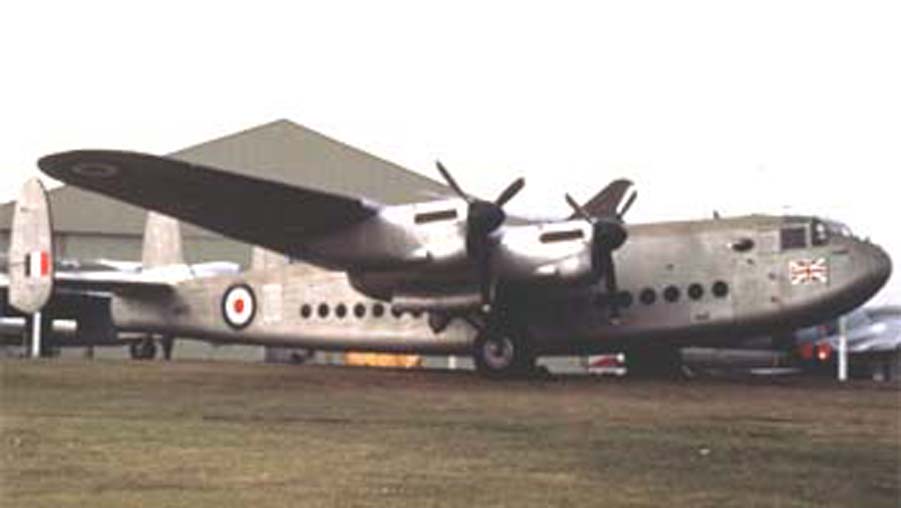

Avro York aircraft
The Military Report included the following:
|
Date: |
18 FEB 1956 |
|
Time: |
12:23 UTC |
|
Type: |
|
|
Operator: |
|
|
Registration: |
G-ANSY |
|
C/n / msn: |
? |
|
First flight: |
1945 |
|
Crew: |
Fatalities: 5 / Occupants: 5 |
|
Passengers: |
Fatalities: 45 / Occupants: 45 |
|
Total: |
Fatalities: 50 / Occupants: 50 |
|
Airplane damage: |
Written off |
|
Airplane fate: |
Written off (damaged beyond repair) |
|
Location: |
near Zurrieq (Malta) |
|
Phase: |
En route (ENR) |
|
Nature: |
Int'l Non Scheduled Passenger |
|
Departure airport: |
|
|
Destination airport: |
London-Stansted Airport (STN/EGSS), United Kingdom |
Narrative:
Avro York G-ANSY took off from Malta-Luqa Airport at 12:21 for a flight
to London Stansted. Shortly after becoming airborne the boost enrichment
capsule in the carburetor of the no. 1 engine failed, causing a fire in
the engine. It is presumed that the engine stopped producing power after
30 seconds of flight. The propeller was not feathered as the aircraft
slowly climbed to 700-800 feet amsl (300-400 feet agl) with a 'crabbing'
or 'yawing' motion to the left. Shortly after retracting the flaps,
while still in a nose up attitude at very low flying speed, the aircraft
stalled and dove to the ground.
The aircraft was engaged to fly Service Personnel from the Suez area to
the UK and had stopped to refuel on Malta. In attempting to return to
the airfield at Luqa the aircraft crashed killing all 50 passengers and
crew on board.
Squadron Leader. Leonard
Cecil Parkes
St George's old boy,
number 120
Leonard Cecil Parkes, born 20 April, 1902, entered St George's in 1906.
Child number 120.
Served in United States Marine Corps c1925
RCAF 1939 - 45 O.C. Squadron Leader.
Commanding Officer of Wireless No2
School Guelph, Ontario, Canada.
Camp X 1940 - 45.
Died, 21 April 1949, serving with Royal Canadian Air Force, he was
killed when his plane (a Hudson)
crashed
on route from Ottawa to New Brunswick. The crash site was not found until
7 years later, by
hunters, in a remote wooded area. Sqn Ldr Leonard Parkes was identified
by the watch he was wearing.

Typical Lockheed Hudson
aircraft.
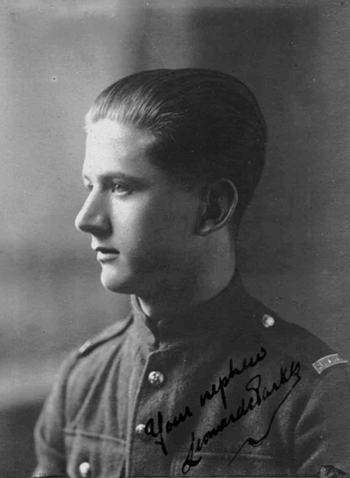

Early photograph of
Leonard C. Parkes
Squadron Leader, Leonard Cecil Parkes. RCAF.
Jack & Dennis Grist
St George's old boys numbered 368 & 363
Jack Grist (368) was born in Skegness, Lincolnshire on 4th August 1915. Before WWII and after leaving St George's he worked at the County Hall Boston.During the war he reached the rank of Captain and was serving in Palestine up to at least 1948 where he met and married an American - Dorothy May Donnell (she was something to do with scouting and the girl guide movement) on 10th March 1948 in Nuseirat. He was in charge of transport.
Dennis Grist (363) was born in Alford, Lincolnshire on 21st may 1921 and died on 26th February 2004 in Boston Lincolnshire.During WWII he spent time in Canada - Winnipeg and Malta. He married Mary Georgiana Pinches in Boston on 16th June 1952 and was a clerical officer with the Inland Revenue.
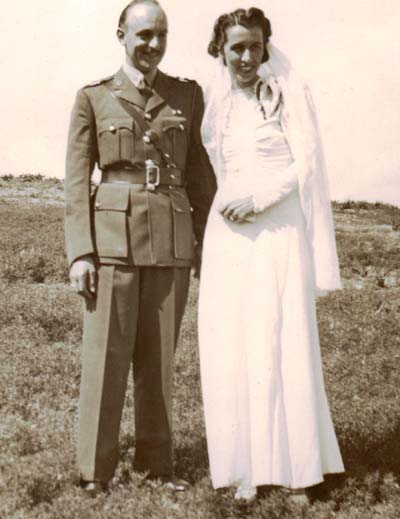

Captain Jack Grist with
his wife Dorothy
Dennis Grist
Photo taken in Palestine, 1948
Photo taken in Toronto
Deus vult